There are places where industrial history is not just a memory in old photographs. The Děčín shipyard is one of them. And in 2026, a new chapter begins to be written here.
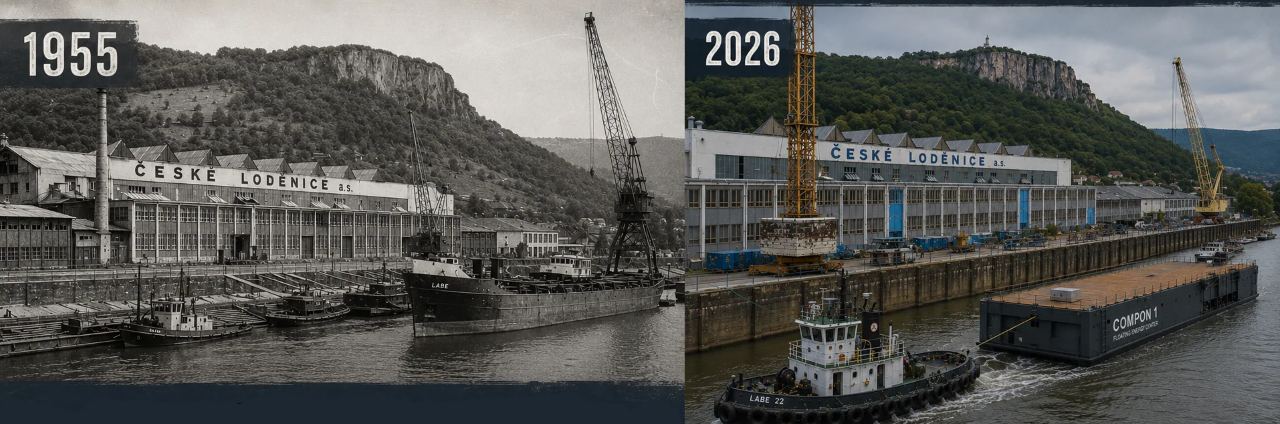
When we place a photograph of the Děčín shipyard from the middle of the last century next to its current appearance, almost everything has changed. Technology, production processes, energy requirements, and the world around us. But one thing remains: the ability to build something on the Elbe River that will set sail from here into the world.
And it is right here in Děčín that the hull production of ComPon 1 is to take place – the first concrete step of a project uniting Czech shipbuilding, mechanical engineering, and modern energy production.
From Ship Hull to Floating Energy Source
ComPon is not a conventional ship. Nor is it just another energy facility built on the riverbank. It is a comprehensive floating energy unit whose concept is being developed by the Czech company JN Infra a.s.
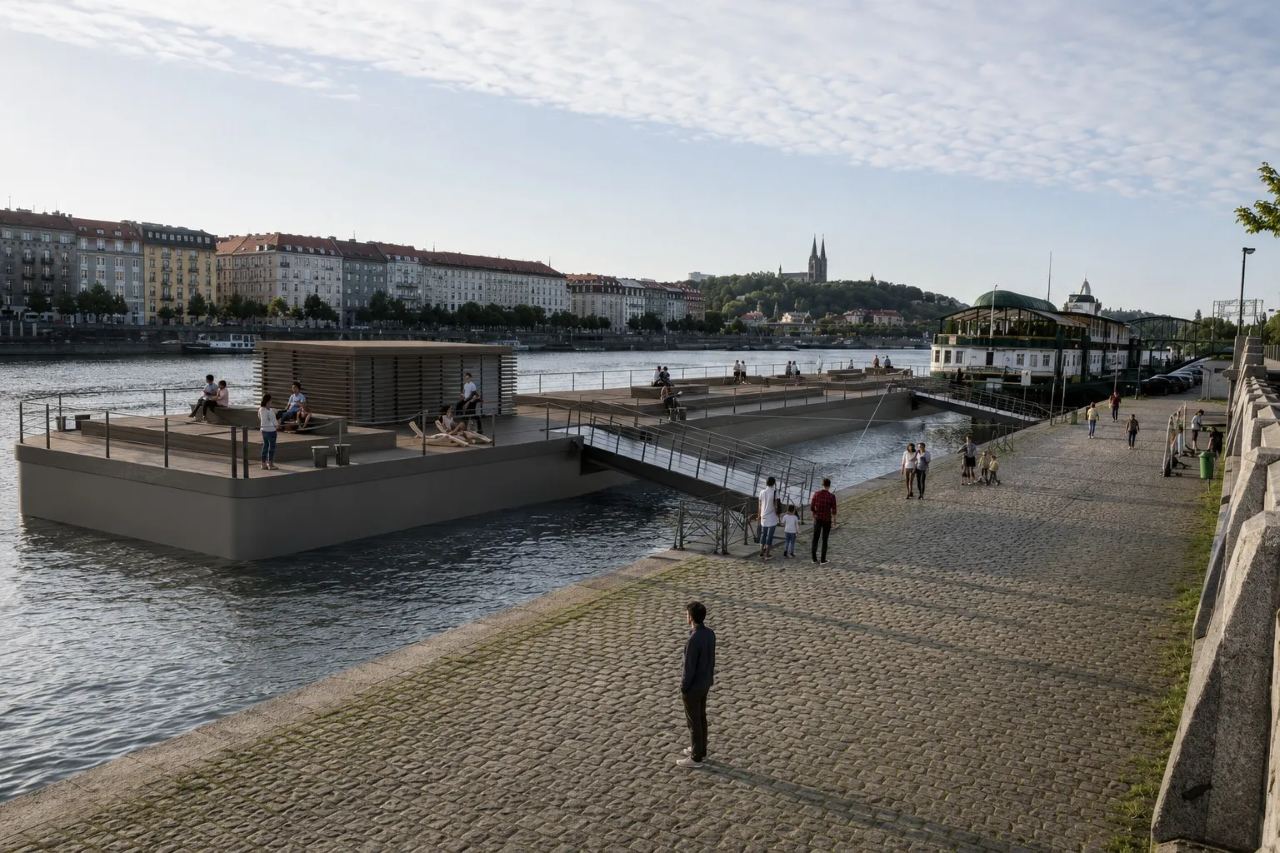
The principle is surprisingly straightforward: leverage the energy potential of the river using water-to-water heat pump technology to generate heating and cooling directly near the locations where they are needed. The technology is integrated into a floating unit, and ComPon is designed as an industrially manufactured and pre-tested system – essentially a Plug & Play solution.
JN Infra plans to deploy this technology primarily in urban areas along rivers. Its pilot community system, SeeDis, is currently being prepared in Prague's Smíchov district. And it is precisely here that the connection between Děčín and Prague gains a much deeper significance.
ComPon 1 will be constructed on the Elbe. Upon completion and testing, the river will cease to be merely an energy source; it will simultaneously become its natural transport route.
Děčín Is No Random Choice
Děčín and the Elbe River have belonged together for generations. Old photographs of the shipyard recall an era when vessels were built and repaired on the riverbank and water transport was a natural part of Czech industry.
Today, a project returns to this environment that uses the same core industrial principles – steel structure, shipbuilding expertise, technical precision, and craftsmanship – but gives them a completely new purpose. It is not a vessel designed for cargo transport being built here. It is a system built to transport energy from the river to the people.
The symbolism is all the stronger because the discussion regarding the future of the Elbe itself has moved forward significantly this year. At the end of July 2026, Czech and Saxon authorities confirmed a coordinated strategy in preparing the Děčín Lock project. The project enters its next stage, and according to the Ministry of Transport, construction could begin in 2029 once the necessary permits are secured.
Therefore, this is not just a nostalgic return to an era when the Elbe was a major industrial artery. It is a question of what role the river can play in the Czech economy over the coming decades.
From a Czech Idea to Czech Manufacturing
JN Infra is behind the technological vision of ComPon. Its ambition is to deploy floating heating and cooling sources not only in the Czech Republic, but gradually in other European river cities as well.
A significant step toward turning this idea into a real industrial installation is the involvement of the Czech shipbuilding industry. The contracting partner for execution is Loděnice Chvaletice, with the physical construction of the ComPon 1 hull planned at the Děčín shipyard site.
This distinction is important. Loděnice Chvaletice brings long-standing experience in the construction and repair of river vessels, including the serial production of river tanker hulls. Furthermore, in January 2026, the business enterprise of České loděnice a.s. was transferred to Loděnice Chvaletice. This creates a powerful combination of experience, infrastructure, and a concrete project.
And Where Does BOILEN Fit into This Story?
Our role is not to rewrite the authorship of the ComPon concept. That belongs to JN Infra.
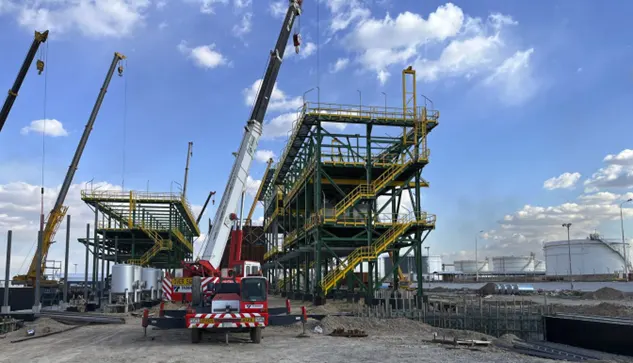
The role of BOILEN s.r.o. is to help bring this idea out of project documentation and into a real industrial environment – through project management, engineering, multi-disciplinary technical coordination, and execution oversight.
This part of the process is often less visible than the final technology, but it is ultimately crucial. Between a great idea and a fully functioning industrial plant lie thousands of technical decisions, drawings, interfaces, quality inspections, deliveries, schedules, tests, and people working as one team. And that is precisely where we come in.
- JN Infra brings the vision.
- The Shipyard brings the manufacturing expertise.
- BOILEN helps bridge project management, engineering, and execution.
One Day, ComPon 1 Will Truly Sail Away
Perhaps this is the most powerful image of the entire project. Not a 3D visualization. Not a presentation. But the moment when the completed ComPon 1 stands at the Děčín shipyard quay, the tugboat tightens its towline, and the complete technological unit sets off down the Elbe toward Prague.
Behind it will lie a place where ships have been built for generations. Ahead of it will be a city where the river's energy will be harnessed to generate heat and cold. And in between will be the Elbe.
The same river that carried Czech industrial products for decades can become a transport route, a production venue, and an energy source all at once. This is no longer a story about the Děčín shipyard's past. It is a story about how its expertise can serve the future today.
1955 → 2026
The tradition of Czech shipbuilding continues. ComPon 1 will be built at the Děčín shipyard. And when it finally leaves the quay behind a tugboat and heads down the Elbe toward Prague, it won't just be another vessel on the river. It will be a Czech industrial project embarking on its journey toward its true purpose.